Barcelona Black Slavery Tour
Did you know that Barcelona’s economic and urban growth is closely linked to the trafficking and exploitation of enslaved people?
After the medieval walls were demolished in 1854, Barcelona, which for almost 2,000 years had been trapped inside tight and overcrowded limits with very little light or ventilation, began to expand. This is when the Eixample district was built. The city became a major textile power, a laboratory of historicist and Modernist architecture, the host of two World’s Fairs, and a cosmopolitan center that projected an image of progress and creativity. In a short time, Barcelona became the economic capital of Spain.
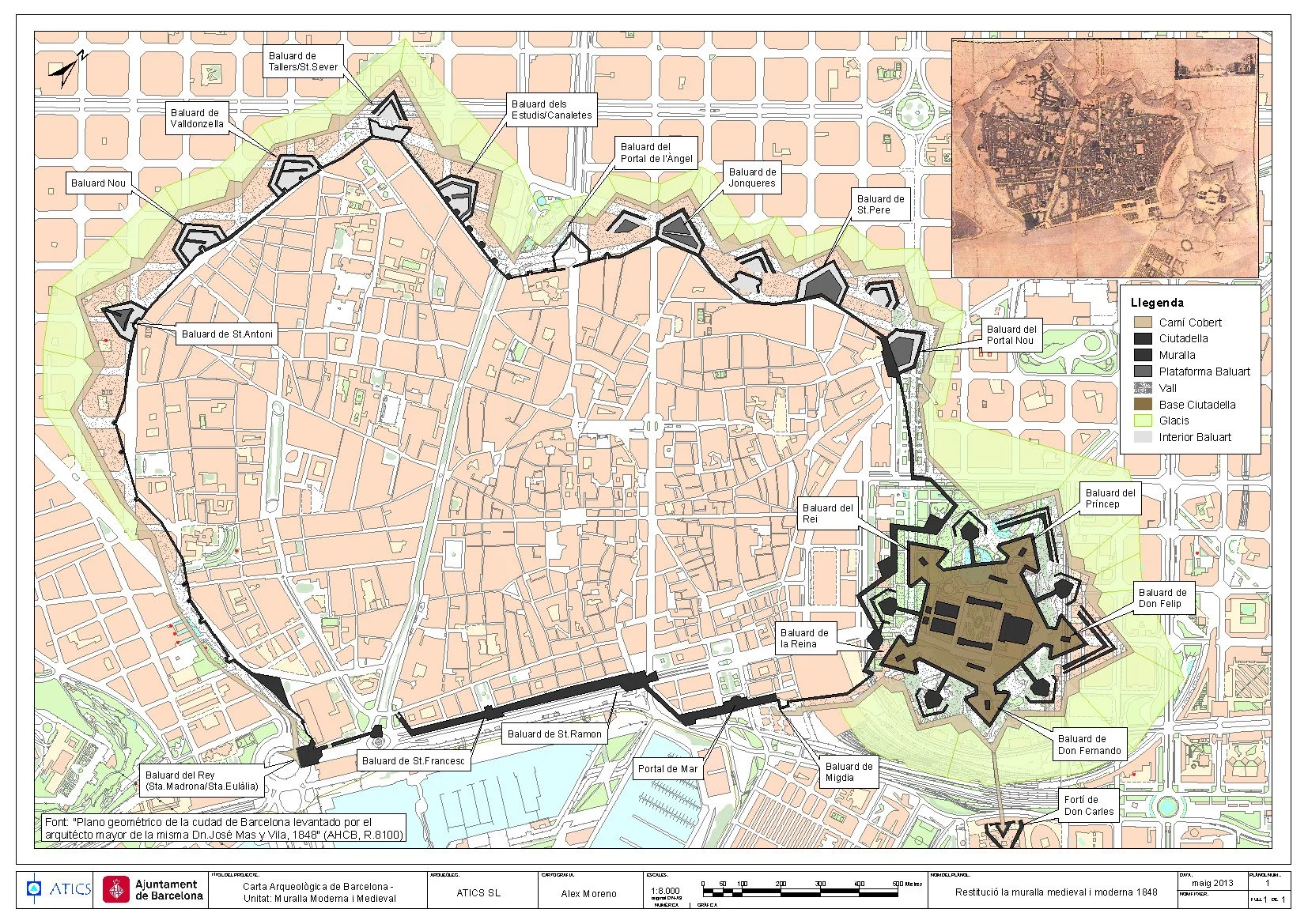
What you see inside the walls (in black) is the old medieval city. The walls were demolished in 1854. The grid built outside the walls is the Eixample district.
But there is a question that many locals rarely ask: where did the money to finance this growth come from?
This expansion was not only the result of local talent or industrial energy.
A large part of the Catalan bourgeoisie, the same families who built factories, created the first railway in Spain, founded banks, financed the Eixample, and later commissioned Modernist buildings from architects such as Gaudí, Domènech i Montaner, or Puig i Cadafalch, had accumulated their family wealth through colonial trade or by exploiting enslaved people on plantations in Cuba, Puerto Rico, and other parts of the Americas. Some of them even took part directly in the kidnapping, transport, and sale of enslaved people, chaining them and shipping them from the west coast of Africa to Cuba and Puerto Rico.
And if you think this was something “normal” that everyone did at the time, the reality is different. The trade of enslaved people had been declared illegal in 1820. Even so, it was such a profitable business that many Spanish families, especially Catalan ones, continued transporting and selling captives for almost 50 more years.
These families mainly lived in Cuba, where they owned sugar mills, tobacco plantations, and different businesses. But as wars of independence spread across the Americas, especially in Mexico, Venezuela, and Colombia, many of them began to fear losing their fortunes. From the mid-19th century onwards, many Catalan businessmen decided to return to Spain before risking everything.
It is estimated that people involved in the slave trade returned with fortunes that today would be worth between 3 and 10 billion euros.
Barcelona became their preferred city to settle in. It was the economic capital of Spain, it was starting its Industrial Revolution, and it was expanding rapidly. The urban development of the Eixample, real estate investment, and new credit companies offered a safe way to multiply capital, something that the colonies could no longer guarantee.
As a result, Barcelona became the European city that benefited the most from Cuba’s slave-based economy in the 19th century. Money from the Americas was invested in textile factories, banks, mansions, theaters, newspapers, and cultural projects, shaping the modern Barcelona we know today.